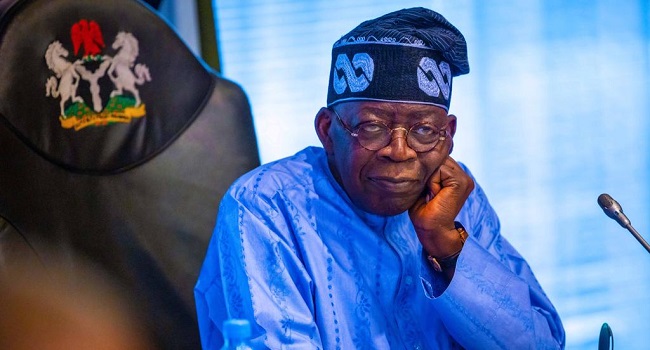
On Wednesday, President Bola Tinubu’s assertion that Nigeria has already met its revenue target for 2025 caused a rift between the All Progressives Congress and opposition parties.
The African Democratic Congress, Labour Party, New Nigeria Peoples Party, and Coalition of United Political Parties accused Tinubu of celebrating statistics while the people of Nigeria face extreme economic hardship, despite the APC’s insistence that the president has set the country on the path to economic recovery.
The President’s claim that the Federal Government had ceased borrowing locally was also met with skepticism by economists, who demanded explanations from the economic managers.
The experts questioned the president’s claim and whether it was in line with the state of the economy by pointing to the Debt Management Office’s and the CBN’s ongoing debt market operations.
Crude oil has long been a major source of income for Nigeria, providing over 90% of foreign exchange profits and over 70% of government revenue.
Oil has continued to be the primary source of income despite repeated promises by succeeding administrations to diversify the economy.
President Tinubu initiated a number of changes to realign the economy after taking office in 2023.
The elimination of the fuel subsidy, which has since caused extreme economic suffering, was one of his most important actions. While the removal increased government revenue, it also increased transportation expenses, exacerbated food inflation, fueled a foreign exchange crisis, and increased the total cost of living for millions of Nigerians.
Under Tinubu’s leadership, states have received more federal funding, but the impact has not been felt locally.
Due to the ongoing rise in poverty, insecurity, and other social ills, many Nigerians are being forced to look for better opportunities outside.
Even while the reforms have resulted in some slight improvements, the burden of hardship on regular people is still too great.
But at the Presidential Villa on Tuesday, Tinubu declared that the nation has achieved its August 2025 revenue target, citing advances in the non-oil sector as the reason.
The President made this announcement when welcoming the founding members of the now-defunct Congress for Progressive Change and The Buhari Organization, which were headed by former Nasarawa State Governor Umaru Tanko Al-Makura, according to his Special Adviser on Information and Strategy, Bayo Onanuga.
“Now, the economy is stable. Paper money is no longer exchanged for foreign currency. The economy is now predictable. To import commodities or get foreign exchange, you don’t have to know CBN Governor Yemi Cardoso,” Tinubu stated.
The President emphasized the notable increase in non-oil income received by the federal, state, municipal, and Federation administrations. Total receipts from January to August 2025 came to N20.59 trillion, up 40.5% from N14.6 trillion in 2024. The government is firmly on track to meet its annual non-oil revenue target thanks to this impressive result, which is in line with predictions, the statement continued.
The President reportedly added that the Federal Government is no longer taking out loans from regional banks to support its robust budgetary performance since the year began.
TInubu, who attributed the growth to his economic reforms, pledged that infrastructure renewal, healthcare, food sovereignty, and security will remain top priorities in his Renewed Hope Agenda.
Tinubu’s announcement that Nigeria had achieved its predetermined revenue target in August was supported by the ruling APC.
In an interview, Nze Chidi Duru, the Deputy National Organising Secretary, revealed this.
We support the President because, he said, “if the year’s target revenue is met in August, it then shows that the budget is capable of implementation; it means that what is set in the budget’s agenda will be implemented and that the government would not, as had been the case previously, borrow money to be able to fulfill the budget of 2025.” This relieves pressure on the government to now start having money to deliver the infrastructure development that it had targeted throughout the year.
Duru maintained that the economy will spiral out of control as a result of the government’s accomplishment.
It will affect all borrowings in a cascading manner. Thus, there would be no pressure on the government. Additionally, it demonstrates that the government can finance the necessary projects to alleviate the nation’s infrastructure deficit, including overhead costs, which have been the main problem, he said.
The APC leader contended that the idea that the current administration may still be interested in bonds and other IMF loans was a fiction of critics’ imaginations.
Daniel Bwala, President Bola Tinubu’s Special Adviser on Policy Communication, urged those who disagreed with the President’s claim that the administration met its income target and refrained from borrowing locally to present opposing evidence.
In an interview on Wednesday night, Bwala charged that the opposition’s criticism of the President’s statement was heedless and pointless.
“Comprehension is the opposition’s problem,” he stated. They are able to see but not see. Despite having ears, they are deaf.
“The President’s remarks from yesterday are quite straightforward, succinct, and self-explanatory.
“The opposition is attacking without a purpose, so I challenge them to provide facts and figures to refute that. I will also politely ask the media to ask them for specifics.”
However, in light of sharp inflation, rising food costs, and currency devaluation, the opposition parties criticized the celebration of revenue data.
The ADC National Publicity Secretary, Bolaji Abdullahi, called the President’s statement “ludicrous” in a conversation with one of our journalists.
He emphasized that the revenue objective has no discernible effect on the lives of the populace and called the economic policies of the APC-led Federal Government “weird.”
“What is the purpose of the revenue target if it does not directly affect people’s lives?” asked the ADC Publicity Secretary. If this revenue aim doesn’t directly affect people’s quality of life, what is its purpose?
Their economic strategy is peculiar since no economy can truly be said to be making any progress if it does not prioritize its citizens. People aren’t aware of it. The reality of the average Nigerian’s existence differs from the reality they are promoting. Impact is what Nigerians desire. They hope that their lives will get better.
The majority of Nigerians are still living below the poverty level, which worries him.
“I will give you one quick example,” Abdullahi went on. The APC-led administration, you know, established the minimum salary at N70,000. It keeps most Nigerians below the poverty line, even if it is set.
Most Nigerians would continue to live below the poverty line. That’s what we don’t understand about this assertion that revenue objectives can be generated when they have no effect.
“People cannot see it when they are unable to see it.” What does revenue serve as? As a result of their massive borrowing, the nation is heavily indebted. Furthermore, we are unable to see how they used the funds.
And the President is asserting that they have achieved the revenue goal based on it. It is therefore ridiculous. Do you know? It’s ridiculous.
The President’s claim was also rejected by the New Nigeria People’s Party, which maintained that governance is more complex than merely raising taxes.
“My question is, if Tinubu meets his revenue targets, has he met the target set out to ensure he looks after the welfare of the people of this country?” stated Ladipo Johnson, the National Publicity Secretary for the NNPP. His administration is a tax-and-spend administration.
According to him, when money is coming in, something is working. In the meantime, you are making matters worse for the nation’s already suffering citizens. Revenue shouldn’t be the only limitation on anything.
The President may have met his personal goal, but he has not yet lived up to the citizens’ expectations, according to the NNPP.
“Yes, the government’s financial success is a wonderful thing. Has the same administration, however, reduced its expenses? Are the funds intended to enhance the presidential fleet, control the Presidential Villa, and purchase SUVs? The questions are these.
Therefore, the President set the goal himself and has graded his own test, regardless of how high or low the bar is. But what about the goal that we, as a nation, set for him? He hasn’t reached our goal. The value of the naira has declined, and inflation is still strong. Right now, it is N1,600. Let him discuss the goals that we as a nation have set for him.
Also reacting, the CUPP National Secretary, Peter Ameh, in an interview , said President Tinubu is disconnected from the realities facing Nigerians.
“I think the president is misunderstanding the yearning and the problems of Nigerians. He’s misunderstanding it in a great deal because he himself, as a president, is disconnected from reality. He has created an alternate universe for himself where he thinks that he’s living in the presidential field and doesn’t know what Nigerians are going through.
“He doesn’t know what Nigerians are going through. So, he thinks that taxing Nigeria and collecting revenue that does not have a direct reflection on the lives of the people is an achievement.
One of his actions has been to determine the investments that should be prioritized when he receives his revenue. Which sector is he investing in that has an impact on people’s lives? It’s not about hitting the revenue goal; are Nigerians’ lives better? Is he spending money on medical care? Is he making agricultural investments? Is he funding our SMEs so they can make more money?
The president has chosen to tax us and raise a sufficient amount of money, yet he is still making a lot of money and taking on a lot of debt. We should have borrowed less money if we were hitting this revenue goal,” he argued.
According to the CUPP scribe, the private lives of people in authority are being financed by the diversion of both revenue and borrowed funds.
“What he’s doing with the money is that he’s spending more on luxury—the opulent lifestyles of those in government—and on transportation expenses and international trips.
Tony Akeni, a factional spokesman for the Labour Party, criticized the President and his party for what he called a “repeated use of lies.”
“I’m glad Nigerians are now aware that the APC’s middle name is a fraud. This is due to the fact that you cannot claim to have stopped taking out loans and then attempt to hide between domestic and foreign ones. Nevertheless, you were announcing this on a global platform.
Do you know that he has taken up this lie in Chatham House in London? They have retaliated against him. You’ll also notice that President Tinubu and his political party have a long history of inconsistency.
“All of this is done to instill a false sense of confidence in the nation and provide weapons of arrogance for the APC’s supporters and their fanatics to continue spreading the false narrative in an effort to mislead Nigerians.”
If the government had reached its revenue goal, he questioned why it was taking out loans.
There is nothing like that, though, because if they have already achieved their goals or thresholds for generating local revenue, why would they increase Nigeria’s burden by taking on a lot of debt from other countries where interest rates are higher, conditions are stricter, and the consequences cause more pain and suffering now and in the future?
The Labour Party’s stance is that everything is false, and Nigerians should be especially watchful as lies are always a sign of a complex plot going on behind the scenes.
In a related development, the president’s declaration that he would no longer accept local loans has drawn skepticism from economists.
The assertion surprised prominent economist Professor Akpan Ekpo, who said, “Perhaps he has information we don’t have.” However, they continue to borrow from outside sources. DMO continues to publish financial documents, and the Central Bank, which is a branch of the government, continues to participate in the debt market. They engage in Open Market Operations, among other activities. I’m not sure what he means when he says that he shouldn’t borrow.
He added that hitting revenue goals would be beneficial, with money preferably going to important areas like infrastructure, education, and health.
“It’s okay if they’ve reached the revenue goal. I hope the remainder would be utilized to address Nigeria’s economic problems. The funds ought to be allocated on infrastructure, education, and health. I was taken aback when the President said that. He said, “I’m not sure what he means.”
Professor Ekpo also emphasized that, as long as transparency is upheld, borrowing can be advantageous when it comes to funding infrastructure. “It’s not something to be proud of if the country is not borrowing, because once they are transparent, borrowing can occasionally be a good way to finance infrastructure.”
Additionally, Babcock University Professor Segun Ajibola emphasized that Nigeria had only just surpassed half of its 2025 revenue target, according to half-year data given by pertinent authorities through the end of June.
He emphasized that the President’s statement requires more explanation from the Debt Management Office and the Minister of Finance.
Examining the data that was made public as of the end of June, as well as the half-year data that was disclosed by the relevant agencies, including the debt management office, the fiscal authority, and the monetary authority. Nigeria had just about met half of the 2025 goal at that moment.
Therefore, I have no idea what might have happened in July and August. I don’t have any more precise statistics than government employees. Perhaps we should hold our breath and wait for more information, particularly from the Debt Management Office and the Minister of Finance,” Ajibola stated.
“If indeed we have been able to meet the annual revenue target in August, then it is wonderful,” said Ajibola, who asked for suggestions on how to better use any potential surplus revenue from September to December if the President’s stated annual revenue targets had been met in August. The revenue flow from September to December is then affected. We can begin discussing potential uses for that excess.
Actually, some of these assertions require context, so it’s important to keep that in mind. It’s highly plausible that what he meant was that we are not going to borrow above the N13tn shortfall, which was estimated in the proposal in the first place.
You recall that at the start of the year, it was predicted that the N13 trillion deficit may increase beyond that amount due to the discrepancy between the market price and the estimated oil price utilized in the budget.
However, given that the nation seems to have been able to boost crude production and that oil prices appear to have stabilized at a level that is comparable to the price estimate we used for the budget, it is possible that the president intended to convey that we would not exceed the N13 trillion (fiscal) deficit that was projected in the budget. It’s not that borrowing won’t be necessary,” he said.
Amolegbe noted the recent DMO treasury auctions and predicted that further borrowing will be required till the end of the year. We will most likely still need to borrow money between now and the end of the year, in my opinion. I mean, yesterday (Tuesday), the DMO had a treasure auction. A couple weeks ago, they held an auction. Other auctions are probably still in the works.
Marcel Okeke, a former Chief Economist at Zenith Bank, was more blunt in his evaluation, labeling the assertion “laughable” and “unrealistic.” He questioned whether the government had ever exceeded revenue forecasts by August of any given fiscal year.
Has this economy ever experienced it? Has the government met and surpassed its income estimates by August of every given fiscal year? To avoid offending the president, I would respond that his assertion is absurd. However, the claim doesn’t seem plausible. According to what we have been reading, there are several continuing borrowing conversations going on, both from within and without, so it doesn’t seem to reflect reality.
By August, they had exceeded their revenue goals and had ceased borrowing. I am at a loss on how to comprehend it.
Richard Mayungbe, a professor of forensic accounting at Copperstone University in Zambia, explained that the Nigerian economy’s recent performance can be attributed to its effective diversification away from its reliance on crude oil.
Mayungbe, who spoke about the President’s announcement, said the move shows a conscious attempt to increase non-oil revenue sources.
“The President has made the economy less dependent on crude oil and more diversified by bringing in money from non-oil sources. This guarantees economic sustainability and is a huge boost for the nation,” he said.
Reviving the economy after years of sluggish growth, he said, is a painstaking process that calls for bravery and strong leadership. He commended the administration for taking decisive action, such as eliminating the oil subsidy, pointing out that the decision had already been made during the final days of the previous administration due to financial constraints.
He went on to emphasize advancements in foreign exchange management, including the stability of the naira and the unification of many FX windows. “You can now obtain foreign exchange without relying on the Central Bank. The majority of banks now permit overseas usage of naira cards, indicating a stabilizing economy, Mayungbe contended.
But according to a half-year evaluation conducted by many investment houses, borrowings were expected to rise in H2.
Nigeria primarily relied on the domestic market for deficit financing in the first half of the year, issuing approximately N3 trillion in Treasury Bills and Bonds. This suggests that a further net issuance of approximately N10.08 trillion may be necessary to cover the estimated deficit for 2025, according to Cardinal Stone’s mid-year outlook, “Charting The Sustainability Path.”
Under its rolling borrowing plan, the Federal Government requested clearance from the National Assembly for $21.00 billion, €2.20 billion, and ¥15.00 billion in the first half.
According to the analysts’ projections, “We anticipate a significant rise in external sourcing in H2 25.” The government’s specific goals are to raise $1.20 billion through the Debt Management Office and an additional $2.00 billion from multilateral sources at favorable interest rates.
“” According to these figures, a total of N4.90 trillion (based on the official currency rate of $1,530.00/$ as of June 1, 2025) may come from overseas, with the remaining N5.19 trillion probably coming from the domestic market when rollovers are taken into account.
According to the study, “we believe that a portion of the external borrowings may be used to finance the cumulative coupons of approximately $1.38 billion and the $1.12 billion Eurobond maturity due in November.”