On Wednesday, President Bola Tinubu posthumously awarded four deceased Ogoni chiefs the title of Commander of the Order of the Niger.
Known as the Ogoni Four, they are Albert Badey, Edward Kobani, Theophilus Orage, and Samuel Orage.
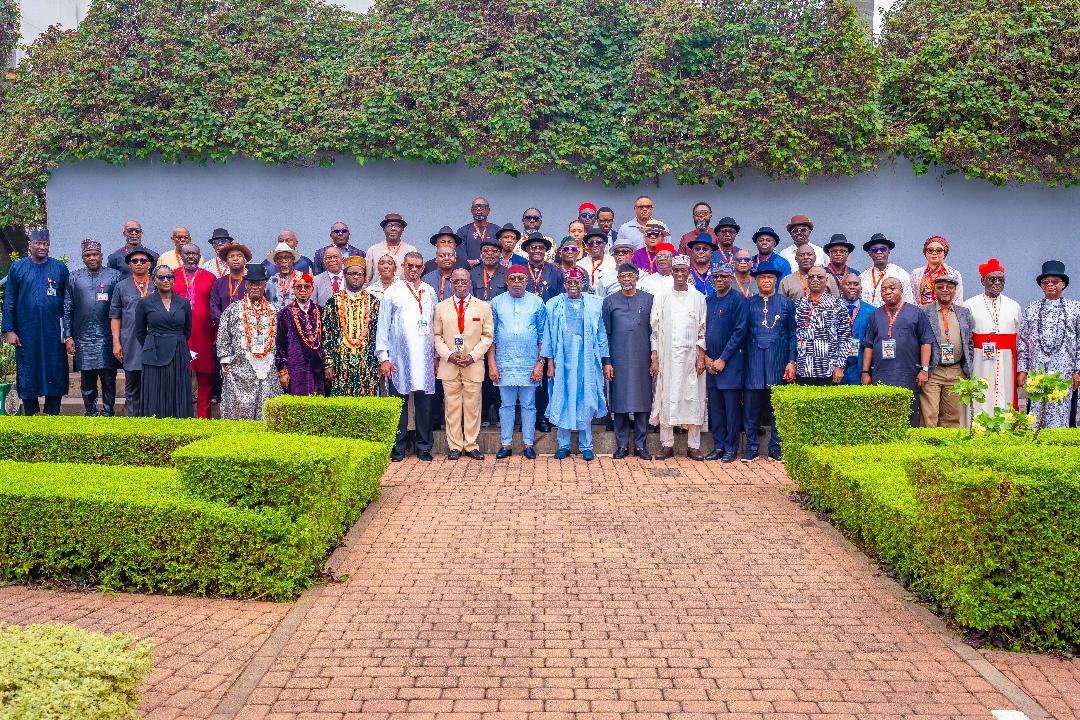
When Tinubu received the Ogoni Consultations Committee’s report at State House in Abuja on Wednesday, he made the announcement.
After decades of division, he implored the people of Ogoniland to embrace unity and healing.
“May their memories always encourage us to be brave, united, and purposeful.
Tinubu urged the Ogoni people from all social levels, communities, and generations to unify, put this troubling chapter behind them, and move forward as a single, cohesive community.
The meeting on Wednesday takes place sixteen months after the President pledged in May 2024 to “pursue diligently and honourably” the cleanup of Ogoni and expand the number of its indigenous people who would benefit from its empowerment initiatives.
In addition, Tinubu promised to protect Nigerian communities’ economic and environmental security while maximising Ogoniland’s potential for human and natural resources.
The President gave stakeholders assurances during the meeting that his administration would help Ogoniland on its path to peace, environmental restoration, and economic growth while also making it easier for oil exploration to resume in the region.
“The overwhelming consensus of the Ogoni communities to welcome the resumption of oil production is encouraging,” he said.
“The government will use all of its resources to help your people on their journey to prosperity for all.”
Tinubu pointed to events in 2022, when the Nigerian National Petroleum Company Limited and its joint venture partners took over the Ogoni oil field’s operations from the Buhari administration.
He said that his administration would respect Buhari’s ruling and expand upon it.
“Let us together turn pain into purpose, conflict into cooperation, and transform the wealth beneath Ogoni soil into a blessing for the people and for Nigeria,” Tinubu said in his final remarks, urging the populace to grasp the opportunity.
In order to finish the procedures for resuming operations, he instructed Nuhu Ribadu, the National Security Advisor, to initiate communication between the Ogoni people, NNPCL, its partners, and all pertinent parties.
The President stated that “a dead asset is not valuable to the community, the country, or the people.” He also instructed the Environment Minister to incorporate environmental recovery and pollution remediation into the larger framework of dialogue with the people.
According to the National Security Adviser, Nuhu Ribadu, who presented the report, the team conducted “this dialogue, community engagement talking with the people and getting to understand to move forward it has succeeded like what you have seen today.” The consultations included all four Ogoni zones, with input from local communities, traditional leaders, and the diaspora.
“All government agencies and institutions, as well as our office directly, received directives from him (Tinubu) that we must implement everything that has been agreed upon and we have taken it,” he explained.
Ribadu reaffirmed the commitment of his administration and all pertinent authorities to bringing peace back to Ogoniland.
“We are going to make sure that peace is restored already, and hopefully you will see the benefit of it not just in Ogoni land but the entire Niger Delta and by extension Nigeria,” he said, adding that we would carefully adhere to his own commands and instructions.
Prof. Don Baridam, the chairman of the dialogue committee, stated that the report represents the Ogoni people’s collective will and that the group made sure all interested parties were included in the process.
According to Baridam, the research reflected the public’s desires for a framework for sustainable growth, renewed environmental remediation, and organised involvement in oil production.
In 1958, oil was first found commercially in Oloibiri, Ogoniland. However, after persistent demonstrations against unfairness and environmental devastation, exploration ceased in 1993.
Ken Saro-Wiwa and nine other Ogoni leaders were hanged by the Abacha dictatorship in 1995 as a result of their following battles to defend their environment against destructive oil development.