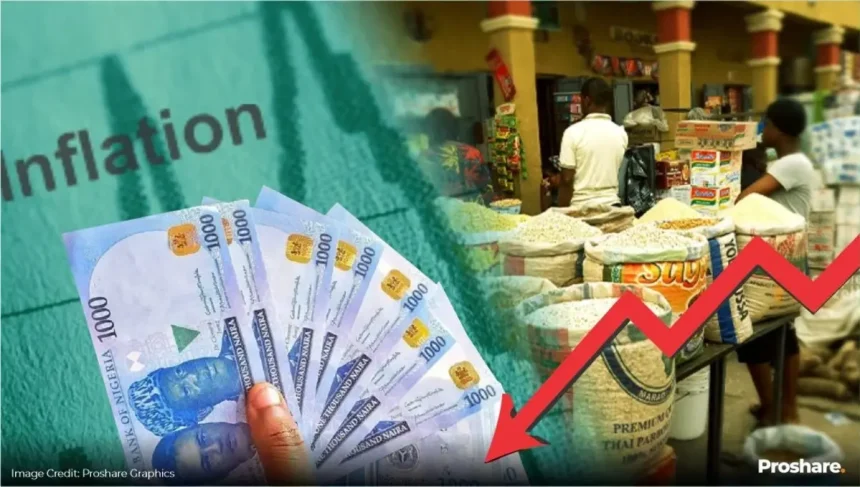
According to data from the National Bureau of Statistics, Nigeria’s headline inflation rate fell to 21.88 percent in July 2025 from 22.22 percent in June, marking the fourth consecutive month of declines.
The July figure was 0.34 percentage points lower than the June rate and 11.52 percentage points lower than the 33.40 percent recorded in July 2024, according to the most recent Consumer Price Index report, which was made public on Friday.
According to the NBS report, the Consumer Price Index increased 2.5 points from the previous month (123.4) to 125.9 in July 2025.
In contrast to the headline inflation rate of 22.22% in June 2025, the headline inflation rate decreased to 21.88% in July 2025.
“When examining the movement, the headline inflation rate for July 2025 was 0.34 percent lower than the headline inflation rate for June 2025.”
The significant year-over-year decline, according to the statistics office, was partially caused by the recent shift in the CPI base year.
Despite the drop in the annual rate, prices continued to grow in the short term, with the month-on-month inflation rate jumping to 1.99 per cent in July from 1.68 per cent in June, suggesting that people are still suffering strong price pressures.
In July, food inflation was 22.74 percent year over year, down from 39.53 percent in the same month the previous year.
Food prices increased 3.12% on a monthly basis, which was marginally less than the 3.25% increase in June.
Slower price increases for vegetable oil, local rice, maize flour, guinea corn, wheat flour, and millet were the main causes of the moderation.
Inflation was 21.08 percent in rural areas and 22.01% in urban areas on an annual basis.
However, monthly price increases in rural areas were more pronounced at 2.30 percent, while those in urban areas were 1.86 percent.
Core inflation, which does not include energy and volatile agriculture products, decreased from 27.47 percent in July to 21.33 percent in July.
As a result of lessening pricing pressures in non-food categories, it decreased month over month from 2.46 percent in June to 0.97 percent.
Yobe (11.43 percent), Zamfara (12.75 percent), and Katsina (15.64 percent) had the lowest annual headline inflation rates at the state level, while Borno, Niger, and Benue had the highest at 34.52 percent, 27.18 percent, and 25.73 percent, respectively.
Even while the data shows that headline inflation has been declining annually, the ongoing monthly rises highlight the fact that many Nigerians still face high living expenses.