
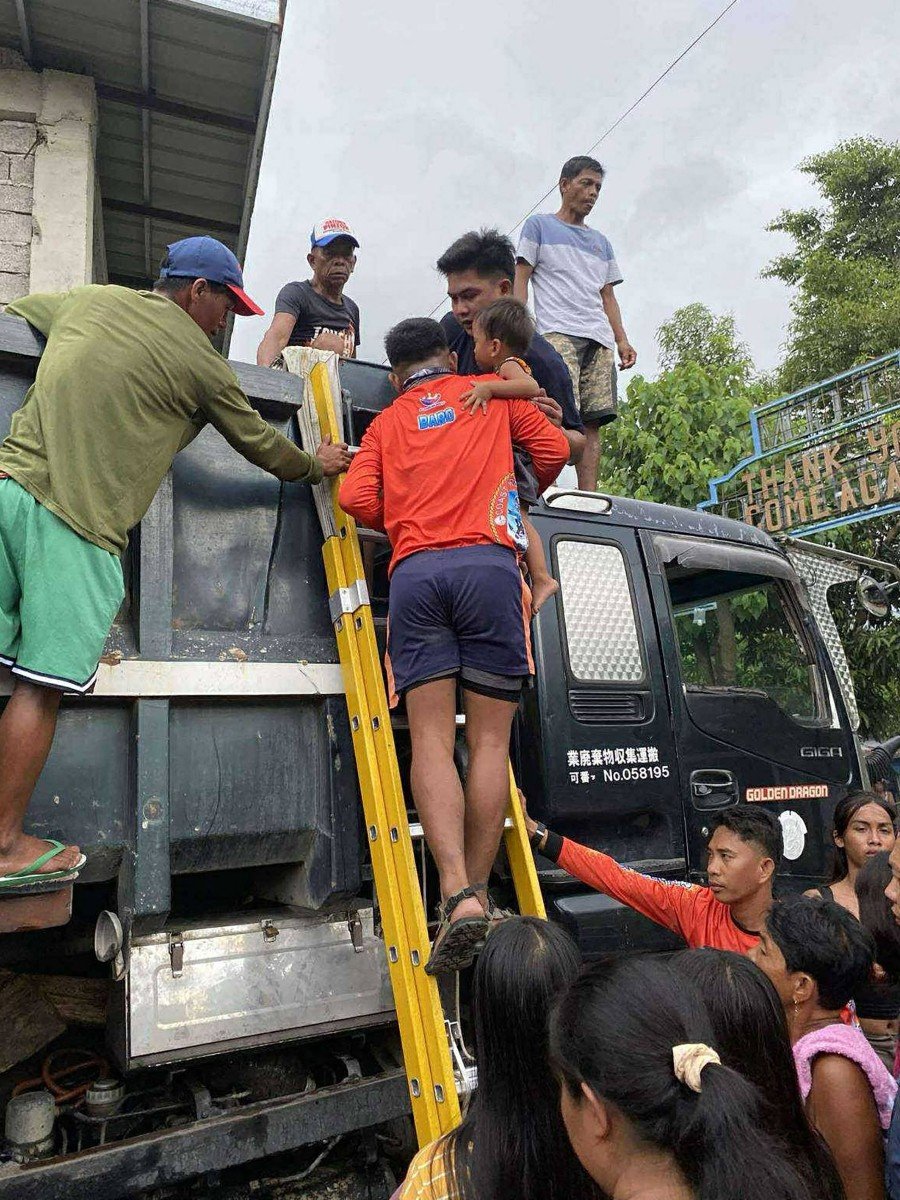
As Super Typhoon Ragasa continued on its collision path with southern China on Monday, inhabitants of the northern Philippines sought cover from gale-force winds, and the Chinese city of Shenzhen started preparations to evacuate 400,000 people.
According to the Philippine weather service, the typhoon hit the Philippines at 3:00 pm (0700 GMT) on Calayan Island, which is a part of the sparsely populated Babuyan group.
The national weather service said that the storm’s center had maximum sustained winds of 215 kilometers per hour (134 mph) as of 5:00 pm (0900 GMT), with gusts as high as 295 kph.
The wind was so powerful that I woke up. According to Tirso Tugagao, a resident of Aparri, a seaside town in the northern Cagayan province, “it was hitting the windows and it sounded like a machine that was switched on.”
Information officer Herbert Singun told AFP that pieces of a school roof had been torn off and landed on an evacuation center some 30 meters (yards) away on Calayan Island, at the center of the storm, causing one minor injury.
He inquired via video chat, “Do you see those coconut trees swaying in the distance?”
Previously, there were eight of them. There are now just four remaining. That demonstrates the typhoon’s strength.
Schools and government buildings in the Manila area as well as 29 other provinces were closed Monday, and little over 10,000 Filipinos were evacuated nationwide.
Authorities in Shenzhen, China, said late Sunday that they would be relocating hundreds of thousands of residents from low-lying and coastal areas as part of a much broader operation.
Due to the typhoon, several other cities in Guangdong province said that public transportation would be suspended, classes and work would be canceled.
Cathay Pacific, based in Hong Kong, stated that it anticipated canceling around 500 flights due to Ragasa’s threat to the financial center.
According to an airline spokesperson, passenger flights into and out of Hong Kong International Airport would stop at 6:00 p.m. on Tuesday and pick back up throughout the day on Thursday.
There was a possibility of “extremely torrential rain” in Taiwan’s east, according to the state weather agency.
It has a storm radius of roughly 320 kilometers, which is rather large. Parts of Taiwan are already feeling the effects of the typhoon’s outer circulation and broad, powerful wind field, even if its center is still some ways away.
In the mountainous regions close to Pingtung, evacuations are still in progress, James Wu, an officer with the local fire department, said AFP.
He went on to say, “What worries us more is that the damage could be similar to what happened during Typhoon Koinu two years ago,” a typhoon that caused sheet-metal roofs to fly into the air and utility poles to collapse.
John Grender Almario, a meteorological specialist for the Philippine government, warned on Sunday that “severe flooding and landslides” might occur in the northern regions of Luzon, the country’s biggest island.
Ragasa’s flooding threat comes a day after thousands of Filipinos demonstrated in the streets against a burgeoning corruption scandal involving poorly built or never finished flood control projects.
With an average of 20 storms and typhoons per year, the Philippines is the first major landmass in the Pacific cyclone belt, leaving millions of people in disaster-prone areas in a state of perpetual poverty.
Scientists caution that the consequences of human-caused climate change are making storms stronger as the planet heats.