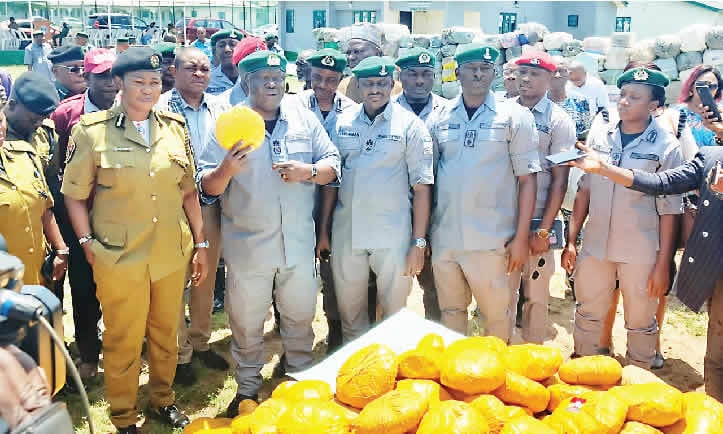
Between September 1 and October 9, 2025, the Nigeria Customs Service, Seme Area Command, reported Thursday that it had captured N1.99 billion worth of contraband along the Lagos–Abidjan Corridor, including expired wheat from Egypt and illegal pharmaceuticals.
Wale Adenuga, the Customs Area Controller, told reporters during his first news conference at the command in Seme Border that the 10,000 bags of expired flour, valued at N1.2 billion in duty-paid value, were transported in five trucks.
Adenuga claimed that if the expired products had made their way into Nigerian markets, they would have presented major health hazards to the general people, including the possibility of infections, food poisoning, and long-term health issues.
One of Nigeria’s busiest and most delicate land crossings is the Seme Border, which is situated in Badagry, Lagos State. Along the 1,028-kilometer Lagos–Abidjan Corridor, which links five West African nations (Nigeria, Benin, Togo, Ghana, and Ivory Coast), it acts as a gateway for trade and travel between Nigeria and the Benin Republic. Up to 70% of West African trade passes via the corridor, making it a crucial commercial conduit as well as a hub for cross-border criminal activity and smuggling.
To ensure that smugglers are forced out of business and promote lawful trade, the command has stepped up its operations over time.
Two suspects have been turned over to the National Drug Law Enforcement Agency for additional investigation, the Seme Customs chief said, adding that the command had seized 1,104 packages of cannabis sativa and 120 packs of tramadol during the review period.
Adenuga stated, “Other items seized within the period include 150 bales of used clothing, 169 bottles of DSP cough syrup with codeine, five used vehicles, and 2,043 bags of foreign parboiled rice (50 kg each).”
He characterised smuggling as economic sabotage that jeopardises public welfare and denies the country essential revenue, emphasising that funds diverted into illegal trade could instead strengthen small and medium-sized businesses and provide employment.
Speaking about exports, Adenuga stated that the Command enabled 53,989.46 metric tonnes of non-oil exports, with a Nigerian Export Supervision Scheme cost of N39.8 million and a Free on Board value of N7.9 billion.
According to the CAC, the shipments included both manufactured items and agricultural produce, indicating that exporters have regained faith in Seme as a potential trading hub under the Economic Community of West African States Trade Liberalisation Scheme.
Adenuga pointed out that the Command produced N1.5 billion in September 2025, an 182% increase from N531.4 million in August.
The Command has stepped up its efforts to streamline processes, improve interagency cooperation, and guarantee that lawful traders reap the full rewards of modernising customs. Our emphasis on trade facilitation has lowered transaction costs, expedited procedures, and eventually raised profits,” he stated.
He reiterated the command’s dedication to striking a balance between its missions of national security, trade facilitation, and income creation while utilising intelligence and technology to effectively administer the border.
The Nigerian Navy Forward Operating Base, Badagry, was also praised by Adenuga for its consistent assistance in stopping the smuggling of rice along the waterways.
As you may remember, during his tenure from February to September 2025, Dr. Ben Oramalugo (Rtd), the Seme Command’s immediate past Customs Area Controller, documented a number of seizures, including bags of rice, worn clothing, and parcels of cannabis sativa, among other items. The seizures were a component of a larger anti-smuggling campaign by Oramalugo’s Nigeria Customs Service, especially along important commercial routes like the Lagos–Abidjan route.
Smuggling via land borders is still quite difficult, particularly when it comes to products like rice, worn clothing, and other things that are illegal. Oramalugo also highlighted facilitating non-oil exports, making sure that items are transported overseas lawfully, and collecting export-related levies.