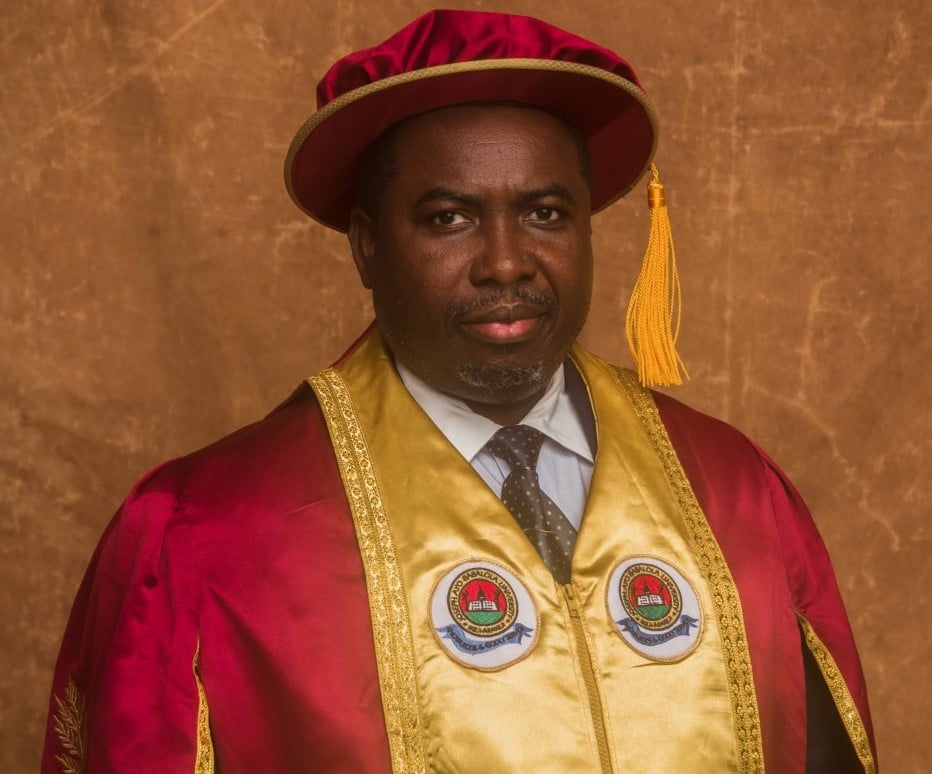
Prof. Joash Ojo Amupitan will be screened by the Senate today (Thursday) for the role of Independent National Electoral Commission Chairman.
Bullah Audu Bi-Allah, the Senate’s director of information, made the statement in a circular that was distributed to reporters in Abuja on Wednesday.
The development occurs just twenty-four hours after Senate President Godswill Akpabio read President Bola Tinubu’s letter requesting Amupitan’s prompt confirmation on the Senate floor.
Part of the circular stated: “The Office of the Secretary, Research and Information would like to inform the public and press that the Senate will screen Prof. Joash Ojo Amupitan, President Bola Tinubu’s nominee for INEC Chairman, on Thursday, October 16, 2025.
The exercise is planned to take place at the National Assembly Complex’s Senate Chamber. We respectfully ask Senate Press Corps members to contribute their customary media coverage and assistance in order to guarantee that the public receives enough information. Television networks are also likely to provide the customary courtesy of live coverage of the occasion.
Amupitan’s nomination, which was approved by the National Council of State last week, represents a major shift for the electoral organisation after Prof. Mahmood Yakubu left INEC after ten years in charge.
Tinubu said that the appointment was made “in line with Section 154 (1) of the 1999 Constitution (as amended)” in his letter to the Senate. requesting that lawmakers give it their “usual expeditious consideration.”
The President wrote: “I am happy to submit to the Senate for confirmation the appointment of Professor Joash Amupitan, Senior Advocate of Nigeria, as Chairman of the Independent National Electoral Commission.”
The timing of Amupitan’s nomination is politically delicate, as controversial post-election evaluations have reignited discussions about INEC’s independence and legitimacy.
Opposition parties and civil society organisations have urged the Senate to guarantee a thorough and transparent confirmation process, notwithstanding the Presidency’s description of him as “an apolitical figure of impeccable integrity.”
Since it will test the administration’s commitment to reliable polling ahead of the general elections in 2027 and set the tone for electoral changes, today’s screening is anticipated to be widely followed across the country.
Attempts by individuals and interest groups to ethnicize Amupitan’s appointment have been cautioned against by the Northern Nigeria Minorities Group.
The group voiced its disapproval of what it called “divisive commentaries and social media tirades” that questioned President Tinubu’s selection of the Kogi-born scholar in a sharply worded statement released in Kaduna on Tuesday and signed by its Convener, Chief Jacob Edi.
Edi pointed out that Amupitan, a native of Kogi State’s Okun ethnic community, represents one of the northern Nigerian minority groups, and that his nomination ought to be hailed rather than politicised.
Edi expressed his disapproval of the continuous efforts by some individuals and interest groups to ethnicize Professor Joash Ojo Amupitan, SAN,’s candidacy as the Independent National Electoral Commission’s chairman.
To be clear, Professor Amupitan is an Okun man from Kogi State, which is one of the Northern Nigerian minority ethnic groups. Each of the North’s 19 states is distinctive and immensely varied; none is better than the others in terms of tribe, language, or religion.
Concerning the President’s decision being portrayed as an act of ethnic preference by “some self-styled northern voices,” he called the story “false, dangerous, and inimical to national unity.”
Edi, who is also known as Kakaki Basanghe, pointed out that this is the first time a member of a northern minority group has been nominated to head the country’s electoral authority in 65 years, since a formal election commission was established in 1959.
“Even when the North-West and North-East held the position consecutively for 15 years, no northern minority group has ever questioned the decisions of successive Heads of State or Presidents to appoint individuals they felt comfortable working with,” the statement continued.
The NNMG asked Nigerians to stop questioning the appointments of northern minority to national posts and to acknowledge them as equal stakeholders in the Nigerian project.
Edi bemoaned the “unfortunate trend” of delegitimising appointments from northern minorities, which started under previous President Olusegun Obasanjo’s government when they were mockingly rejected as “not northern enough.”
“That ugly and regressive trend must end, and the ethnicization of Professor Amupitan’s appointment is a direct continuation of it,” he said.
The group warned that those spreading divisive narratives were “the real enemies of national unity and progress,” emphasising that inclusivity and variety, rather than ethnicity, should characterise the North.
It also listed four main reasons, claiming that the criticism of Amupitan’s appointment reveals a history of discrimination against minorities in the north.
It said, “This June story highlights our increasing worry that some of our northern colleagues still view northern minorities as nothing more than demographic fillers, deserving of neither the recognition nor the privileges that accompany our status in the federation.”
“This kind of thinking is out of date, polarising, and contrary to the spirit of contemporary governance.”
The NNMG asserts that competence, integrity, and capacity—rather than ethnic considerations—should serve as Nigeria’s guiding principles 65 years after the country’s independence.
“We should applaud Professor Amupitan’s selection as a daring step towards meritocracy, equity, and diversity. “If we want to strengthen our democracy, we must internalise these values,” the statement continued.
“We urge political actors, commentators, and citizens alike to rise above petty identity politics and focus on building institutions that work, irrespective of who heads them. The time for ethnic arithmetic is over. The era of competence, fairness, and national responsibility must begin in earnest,” Edi said, praising President Tinubu for “recognising the diversity of the North” and pointing out that the President deserves credit for giving all constituent groups in the region a sense of belonging
Additionally, the group argued that northern minorities are essential to the stability of the Nigerian federation because, taken as a whole, they represent “the real majority” that still believes in the country’s unity and advancement.
When taken as a whole, northern minorities are not merely minority; rather, we are the true majority that supports Nigeria’s unity and advancement, Edi stated. “We must reiterate, without ambiguity, that northern minorities collectively constitute the true stabilising force of this federation.”
He asked Nigerians to support Professor Amupitan as he gets ready to chair the election commission and called for an end to the politicisation of public posts.
“Let our national discourse be defined by competence and justice rather than ethnicity. It is essential to Nigeria’s democracy’s success,” Edi continued.