In an effort to emphasise its demands, the Academic Staff Union of Universities ( ASUU) launched a two-week warning strike on Monday, which resulted in the suspension of classes at several public universities across the country.
The failure of negotiations between ASUU and the Federal Government led to a renewed impasse between the two groups.
Prof. Chris Piwuna, the National President of ASUU, announced the strike in Abuja on Sunday.
At the same time, the National Universities Commission was given a seven-day deadline by the Federal Government to submit the attendance list of all instructors at public universities.
However, the Nigeria Labour Congress criticised Education Minister Tunji Alausa for enacting the no-work-no-pay policy while expressing support for the union.
The proposal, according to NLC President Joe Ajaero, is an act of intimidation that won’t alleviate the issue in the country’s public tertiary institutions.
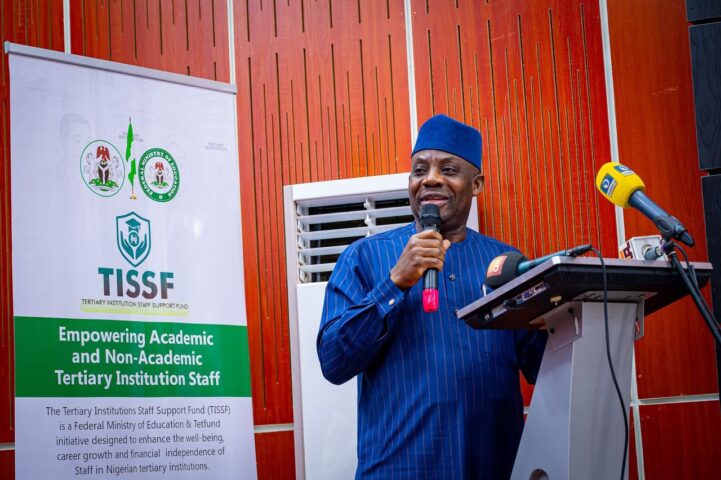
Alausa had asserted that in order to settle the outstanding disagreements over welfare, financing, and the execution of the 2009 ASUU-FGN Agreement, the government had moved into the last stage of negotiations with ASUU and other unions.
According to him, the Tinubu administration has already made great strides by allocating N50 billion for the payment of Earned Academic Allowances and another N150 billion for needs assessment, which will be distributed in three installments.
In a circular issued on Monday in response to the ASUU strike, Alausa instructed vice chancellors and the National Universities Commission to implement the “no work, no pay” policy.
The circular states, “The Federal Government reaffirmed its position on the enforcement of the ‘No work, no pay’ policy with regard to any employee who fails to discharge his or her official duties during the period of strike action, in accordance with the provisions of the federation’s labour laws.”
The minister gave the vice-chancellors of all federal universities instructions to physically count all of the academic staff members at their institutions and perform a roll call right now.
Additionally, he gave them instructions to provide a thorough report that included the names of all employees who were absent or taking part in the strike, as well as those who were present and carrying out their official tasks.
Alausa further ordered that those who neglect their responsibilities not get their income for the duration of the work stoppage.
He explained that those who are not participating in the strike who are members of the National Association of Medical and Dental Academics and the Congress of University Academics are not subject to the directive and would not have their salaries withheld.
In addition, the minister assigned the NUC the responsibility of overseeing adherence to the directive and providing the ministry with a comprehensive report within seven days of receiving the circular.
Within seven days of receiving this circular, the National Universities Commission will oversee adherence to the instruction and provide the Ministry with a comprehensive report.
Alausa asked the heads of the universities to “address this matter with the highest urgency and a deep sense of responsibility in the national interest.”
ASUU president Piwuna, a consulting psychiatrist, responded to the development by saying that the union doesn’t react to threats.
During his Monday appearance on Channels Television’s “Politics Today,” a clearly irate Piwuna also advised the minister against using “divide and rule” strategies.
“We don’t react to danger. We are not threatened by anyone. Just as students perceive themselves as victims of the current situation, we too perceive ourselves as victims of this government. ASUU is prepared, willing, and available to have a final conversation about this issue.
The head of the NLC, meantime, cautioned Alausa against enforcing the “no work, no pay policy.”
Ajaero added that if the minister did not comply with ASUU’s requests by the end of the two-week warning strike, the NLC would be compelled to intervene.
“The NLC won’t stand by and watch if the government doesn’t respond after the two-week warning strike. To create a thorough plan for future interaction with the government, the NLC will call an urgent conference of its affiliates in the tertiary education sector.
“The Nigerian working class is fighting for its rights through the ASUU. Nigeria’s future is at stake in the battle for public education. These unions will no longer be permitted to operate independently by the NLC.
“We insist that the Federal Government provide a tangible plan for the complete implementation of all agreements during this two-week period.
“The decision is straightforward: either uphold the agreements and save public education, or confront the determined and cohesive power of the whole Nigerian workforce.”
Following the walkout, classes were suspended at several public universities around the country.
Shortly after a congress at the university’s main campus in Samaru, Zaria, ASUU-Ahmadu Bello University branch chairman Haruna Jibril verified the compliance, stating that the decision represented the academic staff’s united willingness to push home their long-standing demands.
“We have fully cooperated with our national body’s directive. After the congress, Jibril told reporters, “We are hopeful that the level of compliance will remain total throughout the two-week period, even though this is the first day of the strike.”
“The government’s failure to meet the union’s demands has made continued patience untenable,” he said, adding that the union had no choice but to join the statewide warning strike in solidarity with the national body.
“Despite years of disregard by succeeding administrations, our members have remained strong and resilient. Jibril stated, “This strike is about the future of our universities and the welfare of both staff and students, not for personal gain.”
Clusters of students talking about the development took the place of the typical commotion of academic life at the institution’s Kongo and Samaru campuses.
Students waited idly in groups in empty lecture halls at the Faculty of Education. There were a few professors visible on the campus, but none of them went into the classrooms to instruct.
Shafiqah Abdullahi, a final-year student, said, “This is not like a typical Monday.”
“Today has been a lecture-free day. Although the professors were around, none of them showed up to give lectures. For those of us in our final year in particular, this news will not bode well. If the strike goes on, I think we will be the ones who suffer the most.
The PUNCH saw that some students at the Faculty of Social Sciences had recently finished an exam, while others were unsure about their next academic assignments.
Library and Information Studies student Hassan Kugu reported that his department was able to conduct a test in the morning prior to the strike’s full implementation.
The fact that it was only the first day might be the reason. We were hoping to write another test tomorrow after successfully writing one this morning. However, since the majority of ASUU members were still meeting at the time we wrote, I believe we were permitted. Given that Congress has certified complete compliance, tomorrow’s exam might not be valid,” he clarified.
In response to the Federal Government’s “No work, no pay” policy, Jibril stated that union members were not scared by such statements and described them as tried-and-true strategies that would not end their fight.
“We are not alarmed by the government’s threat, but we do take it seriously,” he stated. This is nothing new to us. We went eight months without pay during the last significant strike, but our members refused to back down. Due to problems with the Integrated Payroll and Personnel Information System, several of our coworkers have been unpaid for more than 30 months. Basic needs are frequently not met by even the current salaries.
Academic operations were also suspended at Usmanu Danfodiyo University in Sokoto when the ASUU chapter there joined the strike.
In an interview, Professor Nurudeen Muhammad, the chairman of the UDUS ASUU, acknowledged the situation, stating that members began the strike action at midnight in accordance with the union’s national headquarters’ directive.
“In accordance with the national directive, we have been a part of the strike since midnight today,” Muhammad said.
“Our members will continue to fully observe the two-week warning strike until we receive instructions to the contrary,” he continued.
Ondo State universities also joined the nationwide strike on Monday. Academic activities at Adekunle Ajasin University Akungba Akoko were reported to be nonexistent. Although their lecture rooms were open and no lectures were taking place, students were observed moving around the campus.
The AAUA lecturers were already on an indefinite strike prior to the nationwide walkout after a confrontation with the state administration over pay and benefits.
Prof. Bolu Oshodi, the institution’s ASUU chairman, commented on the development and stated that his members followed the union’s national leadership’s instructions.
It’s a double strike for us now because, as you are aware, we had already been on a local strike. I want to make it clear that, even if the national issue is ultimately handled, we will not restart if our local difficulties are not resolved.
“So, everyone has joined the strike throughout the federation,” stated Prof. Olorunsola Rotimi, the immediate past chairman of ASUU at Olusegun Agagu University of Science and Technology, Okitipupa. ASUU’s NEC passed a resolution. In accordance with the employment legislation, we have so given the government a 14-day notice.
Additionally, instructors at the Joseph Sarwuan Tarka University Makurdi, previously the Federal University of Agriculture, resigned.
Dr. Terseer Abari, the university’s ASUU chairman, informed reporters that the chapter had followed the instruction. “We have adhered to the national directive,” Abari stated. Thus, we are currently on strike.
The institution’s examination was interrupted by the warning strike. Although most students had finished their exams, Abari stated that those who were still taking them would need to take them after the strike.
“With the exception of those in the Veterinary College who still have one or two papers to complete, a good number of our students have finished their exams,” he stated. However, everything else will be taken away as we continue the strike. Ninety-five percent of our pupils have finished their exams, so they will round it off when we return. You will only observe people working on their projects if you visit our campus. After the strike, these individuals will return home.
Although there was no lecture taking place, students could be observed at Fr. Moses Adasu University in Makurdi, which was once Benue State University.
At the University of Uyo, social and academic activity were equally crippled. No lessons were given on Monday since the classrooms were empty, according to our journalist who visited the University of Uyo’s two campuses. Students and lecturers were observed talking about the strike while standing in groups.
“The strike has officially kicked off through our procedures and Congress resolutions,” said Prof. Olajide Opeyemi, the ASUU Branch Chairman, who verified the labour action. It was an order from our union’s national organisation.
An analogous circumstance was seen at the University of Ibadan, where the instructors followed the ASUU mandate. Adefemi Afolabi, the Branch Chairman, stated that the university’s academic operations are currently on pause.
“The union’s national secretariat’s directions are being followed. The warning strike began at midnight on Sunday and will continue until the union issues a counter-directive. We are visiting departments and faculties to make sure that all instructions are followed. The site is devoid of academic and related activity,” he said.
When our correspondent visited the university on Monday, there were no lecturers at Nnamdi Azikiwe University in Awka. Professor Dennis Aribodor, the chairman of ASUU Owerri Zone, pleaded with the federal government to act morally.
Instead than threatening to take action, the Federal Government should fulfil its pledges as part of its paternal responsibilities. He declared, “We’re willing to wait ten years until the government takes the necessary action.”
The lecturers at the University of Jos complied fully with the strike order. The majority of the teachers stayed off campus, leaving students who arrived for lectures stranded, according to our correspondent who visited the Bauchi Road campus on Monday afternoon.
Prof. Jurbe Molwus, the chairman of the ASUU branch at UNIJOS, stated in an interview conducted in Jos that the lecturers were fully adhering to the warning strike.
Molwus declared, “We are fully adhering to the warning strike at UNIJOS.”
Despite the Federal Government’s threats of “no work, no pay,” we are not scared and will not back down. Until the government complies with our requests, we will not stop complying.
Dr. Monday Hassan, the chairman of the ASUU Branch, verified that the situation was the same at Plateau State University in Bokkos.
The three universities joined the nationwide strike, according to confirmation from Dr. Adewale Ositoye, Branch Chairman of the ASUU at Tai Solarin Federal University of Education in Ijagun, Dr. Ola Oyedele, his counterpart at the Federal University of Agriculture in Abeokuta, and Ago Iwoye, an official from Olabisi Onabanjo University.
According to Ositoye, his coworkers at TASUED have refrained from entering the lecture halls until the 14-day warning strike has ended.
Temiloluwa Timothy and Benjamin Okoli, two FUNAAB students, expressed regret for the interruption to the school’s academic schedule.