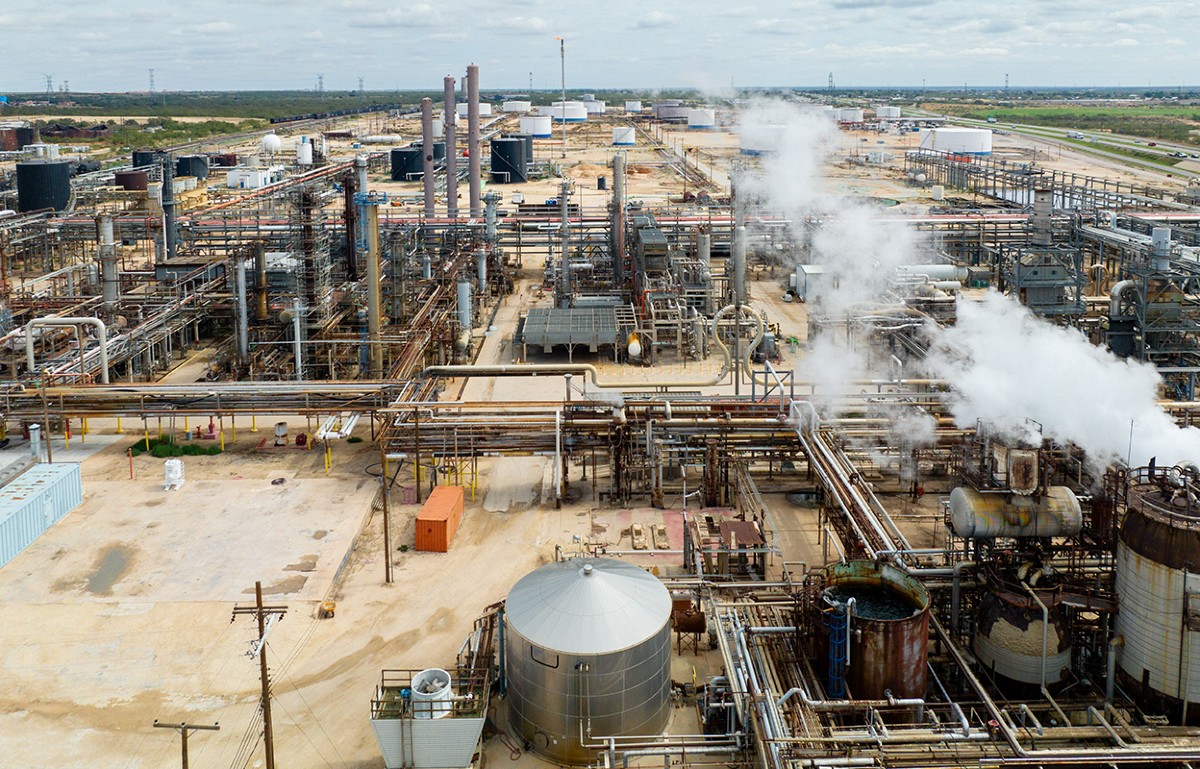
Despite the more than $3 billion contract amount to revive them, the refineries in Port Harcourt, Kaduna, and Warri are decaying away, according to a report.
Our correspondents in Rivers, Kaduna, and Delta states visited the refineries and confirmed that the massive sum—which is currently being investigated by the Economic and Financial Crimes Commission—did not provide the expected outcome.
It was discovered that because they had nothing to do, refinery workers can start and stop working at any time.
The nation’s long-standing battle with state-owned refineries, which have cost billions in lost income as a result of their dependency on imported petroleum products, is the context for these discoveries.
Nigeria imports almost all of its refined petroleum needs, despite having Africa’s greatest oil producer. This has contributed to decades of economic hardship and accusations of corruption.
The Nigerian National Petroleum Company Limited has been in charge of several rehabilitation projects since the early 2000s, according to public records and official declarations, however promises of operational revival have not always been fulfilled.
The goal of the roughly $3 billion upgrade in the main facilities was to break the cycle.
Nonetheless, the study presented a picture of incompetence, missed deadlines, and systemic failure.
Allegations of fund misappropriation are the reason for the EFCC’s involvement.
The anti-graft agency interrogated the NNPCL’s top officers and recently fired managing directors in May 2025 on the alleged mismanagement of the $3 billion.
Port Harcourt Refinery unkept Promises amid shutdowns
The Port Harcourt Refining Company, which is situated in Alesa, Eleme Local Government Area, Rivers State, is made up of two units: a contemporary 150,000 bpd facility from 1989 and an older 60,000 bpd plant founded in 1965. Together, both units have a capacity of 210,000 bpd.
Once a centre for the production of petrochemicals, petrol, diesel and kerosene, the refinery closed in 2019 as a result of vandalism and obsolescence.
Restoring full capacity was the goal of the three-phase, $1.5 billion repair, which was expected to be finished by 2025.
Resumption at 70% was announced in November 2024 by Mele Kyari, the then-NNPCL Group Chief Executive Officer. He projected that 1.5 million litres of diesel and 2.1 million litres of low-pour fuel oil would be produced daily, in addition to 1.4 million litres of petrol and 900,000 litres of kerosene.
Findings, however, indicated that problems only occurred after short operations.
Olufemi Soneye, a former NNPCL spokesperson, declared a 30-day shutdown for regular maintenance on May 24, 2025.
In June 2025, stakeholders, such as the Host Community Bulk Petroleum Retailers Association, voiced their surprise and urged timeline adherence to prevent misleading Nigerians.
Stakeholders representing the Port Harcourt Refinery Depot under the auspices of the Host Community Bulk Petroleum Retailers Association expressed surprise at the extended shutdown on June 5.
They warned that failing to follow through on the 30-day timetable that the Federal Government had previously committed would be tantamount to ignoring Nigerians.
NNPCL stated in July 2025 that it was examining the plans for repair.
The NNPCL reversed course on full rehabilitation in August 2025, acknowledging mistakes in the $1.5 billion project and recognising its unfinished condition.
When Sunday PUNCH visited the refinery again , it found that no production was occurring and the facility had remained idle.
Employees were observed coming and going while performing administrative tasks.
Activities at the PHRC depot, which is next to the refinery’s main complex, come to a complete stop.
There was no kerosene or petrol being lifted in the once-crowded truck park. The only material being trucked out of the old stock was Automated Gas Oil (diesel).
The Federal Government misled Nigerians with the 2024 opening of the 60,000-barrel-per-day facility, according to some marketers lounging around the depot, who called the situation deplorable.
According to one of them, who wished to be named only as Toku, “The depot has only loaded a few trucks since Mele Kyari last visited. Since then, the refinery has not operated until present. They were only loading DPK and AGO from the previous stock about three months ago, but today they are just loading AGO. Nothing is coming out of the refinery. It’s not functioning. Therefore, let the government cease misleading us.
The management had intended to test-run the plant the week before, but nothing happened, according to another marketer, who spoke on condition of anonymity so as not to be victimised.
We, the independent marketers, are unable to purchase from the refinery because it is too costly; some of us go to private depots, which are less expensive. “From what I heard, they said the loading bay is faulty. So here, they are only loading AGO. However, another thing is that only major and mega companies like NNPC and Oando are lifting for now,” he continued.
Warri refinery: Brief revival, swift collapse
With a capacity of 125,000 barrels per day, the Warri Refining and Petrochemical Company was founded in 1978 and has a history of manufacturing petrochemicals and fuels, including carbon black and polypropylene.
According to publicly available data, it has been inactive until the most recent rehabilitation after being closed in 2015 owing to pipeline vandalism and technical issues.
In 2021, the Federal Government authorised $1.4 billion for Warri and Kaduna, of which Warri received $897.6 million.
After ten years, resumption was announced by Reuters on December 30, 2024.
Kyari predicted that initial activities would be 60% when he declared it open.
Results by Sunday During a recent visit, PUNCH discovered that the factory was not in production.
There is no flare visible from the chemical facility, and the tanker park is similarly deserted.
When one of our correspondents arrived, the property seemed empty except for employees who come and go for administrative tasks.
The WRPC employees arrive at work as usual and leave whenever they like, according to a person with knowledge of the operations. The refinery is not operating; people are only getting paid.
However, according to a different source, some maintenance was still being done when the current NNPCL administration issued a new policy order.
Each administration of the NNPCL has its own set of rules. He continued, “This administration has not yet announced its strategy regarding Warri Refinery.
Kaduna refinery: Endless rehabilitation
The same is true for the Kaduna Refining and Petrochemical Company. Its operations, which were once characterised by noisy machinery, furnace flames, and busy worker traffic, are no longer there.
The property seemed deserted except for a single police post with a faded signboard.
“There once was life here. You would hear the sound of labour and see the furnace’s flames. Nothing now. Paulina, a barman in Kapam, a neighbourhood that borders the refinery, said, “They keep saying’maintenance,’ but we have heard the same story for years with no end in sight.”
Aisha Mohammed, another local, claimed that all of the assurances regarding the refinery’s launch had fallen through.
“It will be beneficial even if the refinery begins operations at 60%,” she stated. Similar targets were promised the last time, and once we witnessed flames, there was silence. We’ve had enough of promises.
Nothing had changed, according to a security guard at the gate.
“They say ‘quick-fix,’ but the fix feels slow,” he remarked. Not much has changed: there are still no jobs or gasoline, only poor roads and exorbitant costs.
Locals, meanwhile, claim that not much has changed.
John, a resident of Kapam, said, “This is like the coming of our Lord Jesus Christ, everyone is waiting, and it is not coming.”
The Kaduna refinery has cost billions of naira with no return.
A $740.6 million deal for a “quick-fix” repair was signed by the NNPCL in February 2023, with officials guaranteeing 60% output capacity by December 2024.
However, detractors claim that due to missed deadlines, the money has been wasted. Additionally, the EFCC stated that it was looking into the rehabilitation funding.
The project could be further crippled by extended inactivity and shrinking workforce, according to a former refinery engineer who spoke on condition of anonymity to avoid being singled out.
“Corrosion develops in refineries that are left idle for extended periods of time. Even once turn-around maintenance is finished, more personnel will be required. Less than 100 employees remain from the previous 1,200, he added.
The refinery’s collapse has severely damaged the livelihoods of people living in Kapam and the surrounding areas.
Shops, transport companies and residences that were formerly reliant on the facility’s operations have ceased operations.
Musa, who owns a kiosk close to the gate, said that employees used to visit our stores daily.
People barely ever pass here anymore. Security personnel have also been cut. Unlike before, we now rely on little things to survive.
The NNPCL stated that it was dedicated to offering the three refineries a long-term solution to their problems.
“The NNPC is committed to offering a sustainable solution to its three refineries in order to restore them to full operations,” stated Andy Odeh. The refineries in Port Harcourt, Kaduna, and Warri are undergoing thorough technical and commercial evaluations.