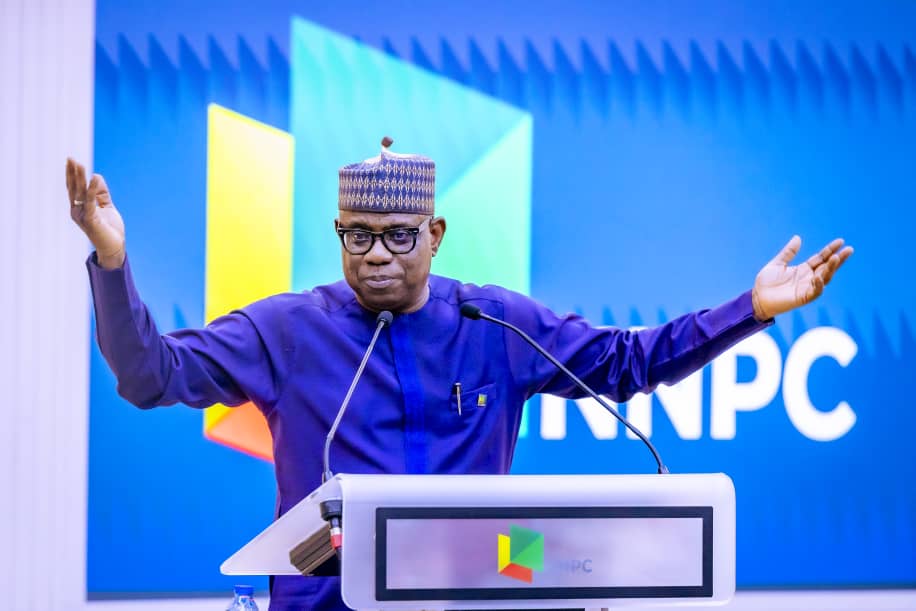
Bashir Ojulari, the group chief executive officer of the Nigerian National Petroleum Company Limited (NNPCL), has expressed regret over the losses in gas and crude output brought on by the three-day strike by the Petroleum and Natural Gas Senior Staff Association of Nigeria.
Ojulari wrote to the Nigerian Midstream and Downstream Petroleum Regulatory Authority and Nigerian Upstream Petroleum Regulatory Commission to explain that the country experienced a 20% power supply shortage and a 16% oil production and 30% marketed petrol loss as a result of the suspended strike.
The National Security Adviser and the Director General of the Department of State Services also received a letter from the national oil firm headed “Impact Assessment of ongoing industrial action,” dated September 29, 2025.
Major oil terminals, gas plants, and power facilities had to close due to industrial action brought on by a dispute between the union and the Dangote Refinery. This resulted in the daily deferment of 283,000 barrels of crude oil and 1.7 billion standard cubic feet of gas, cutting off vital revenue streams from the nation’s two largest sources of income.
Following the Federal Government’s intervention, the union leadership stated that its statewide strike against Dangote Petroleum Refinery would be suspended. However, they emphasised that the truce was only temporary and may be renewed if the outstanding issues were not resolved.
According to the report, PENGASSAN and the 650,000 refinery’s management have been at odds.
The conflict arose from PENGASSAN’s accusations that the Dangote Refinery replaced some Nigerians with foreign nationals and engaged in mass transfers and terminations of union members, which the corporation has continuously refuted.
The management of the refinery said that operational needs, not union activity, were the reason for the worker rearrangement.
The union’s industrial action, which involved cutting off the refinery’s supplies of petrol and crude oil, intensified the impasse and raised concerns about possible interruptions to the country’s energy supply and economic stability.
The Federal Government stepped in to break the deadlock after raising worries about the dispute’s potential to have “adverse effects on the economy and energy security.”
In the letter our correspondent was able to receive on Wednesday, the NNPCL GCEO detailed the financial losses and stated that considerable production deferments were caused by industrial action.
Ojulari revealed that as of September 29, 2025, production deferments amounted to 283,000 barrels of oil per day, 1.7 billion standard cubic feet of petrol per day, and more than 1,200 megawatts of electricity generation during the first 24 hours of the strike.
He claims that this amounts to about 16 percent of the country’s oil production, 30 percent of its sold petrol and 20 percent of its electricity supply, and that if the scenario persists, the effects will likely worsen.
Production deferments as of September 29, 2025 (within the first 24 hours of the strike), were estimated to be around 283 kbpd of oil, 1.7 bscfd of gas, and more than 1,200 MW of power generation impact. This corresponds to about 16% of the country’s oil production, 30% of its marketable gas, and 20% of its power production. The effects are anticipated to worsen if the scenario persists, presenting a real risk to the country’s energy security, the GCEO stated.
Approximately 1.7 billion standard cubic feet per day were brought offline during the strike, causing significant losses for the gas industry as well. According to industry statistics, this volume corresponds to nearly 1.7 million Mcf of petrol each day, or 1.76 million MMBtu per day when converted at a rate of 1.037 MMBtu per Mcf.
He added that at least five planned key maintenance tasks have been impacted, and that the deferments are probably going to get worse in the future. These consist of SEPNU EAP IGE, AKPO GT-3 pigging, H2 well testing, USAN turnaround maintenance, and yearly compressor maintenance.
Ojulari also disclosed that the anticipated restoration of approximately 100,000 barrels of crude oil per day and 1.341 billion standard cubic feet of monetised gas across Joint Venture and Production Sharing Contract assets this week has now been postponed.
Ojulari pointed out that activities were still severely restricted, even if a small percentage of non-unionized employees were still enabling crude exports.
He issued a warning that planned and existing lifting activities throughout the terminals would probably experience further financial losses in the upcoming months, increasing the possibility that foreign buyers would file demurrage claims.
For example, the strike prevented the finalisation of documents, which caused the loading of an almost-completed NNPC shipment to stop at the Brass Terminal. He claimed that demurrage fees had already been incurred as a result of the delay.
The head of NNPCL emphasised that the financial burden was increasing quickly and that, at the present delay levels, large revenue losses were anticipated.
He said that the company’s cash flow was under “immediate and compounding pressure” as a result of missed crude lifts and interrupted petrol sales.
We firmly believe that the effects of the ongoing industrial action stretch beyond the Dangote Refinery. Systemic hazards to the energy supply, the security of people and assets, and the overall economy are presented by the disturbances. In order to protect national energy security and stability and to avoid such a significant disruption of the entire energy security infrastructure, a durable solution is needed,” he said.
The PENGASSAN leadership, meanwhile, emphasised that the decision to temporarily halt the statewide strike was not a sign of faith in Dangote but rather a gesture of respect for federal institutions and government mediation attempts.
Despite serious concerns about the Dangote Group’s genuineness, Osifo said that by caving in to government pressure, the union was adopting the “moral high ground.”
“We are only suspending, not calling off this strike,” Osifo said during a news conference in Abuja on Wednesday. We will not provide any warning if any element of this agreement is broken. We’ll start our halted industrial action right away.
Insisting that members join the union “to secure better welfare and fair pay,” he emphasised that the industrial action was based on workers’ fundamental right to freedom of association.
He warned that the union’s patience should not be interpreted as weakness and stated that PENGASSAN is still unhappy with certain parts of the statement that was signed under the Ministry of Labor’s supervision.
“Yes, we are aware that Dangote disregards the rules of engagement,” Osifo stated. Yes, we are aware of Dangote’s desire to demonstrate his unwavering power and disregard for the law. Yes, we are aware that several of our members are still employed within the refinery today.
Indeed, some of our members are still employed by the group’s enterprises today. Indeed, we are aware, think, or suspect that Dangote may slack off on some of the things the government has asked him to perform, just like he did with NUPENG. We suspect something.
We genuinely don’t think he’ll fulfil his end of the agreement. We genuinely don’t think he’ll meet our expectations. We don’t think. However, the NEC has chosen to listen to them because we respect government, institutions, processes, and procedures. We also respect the government officials who stayed up until nearly four in the morning this morning in an attempt to resolve this issue. despite our shared conviction that Dangote will not act morally and our concerns that the document did not accurately reflect our requests.
Despite the document’s flaws, PENGGASAN’s National Executive Council has made the decision to take the moral high ground and suspend the industrial action that was initiated on Sunday, September 28, 2025, in order to demonstrate to the government that we are a remarkably patriotic nation that loves this country more than any one person.
He highlighted that the dispute concerned workers’ fundamental rights to fair compensation and freedom of organisation.
“Remember, we didn’t cancel; we are only suspending. Any lapse on the side of Dangote would be constantly watched and monitored by us. We shall not provide any notice or warning and will immediately resume the paused industrial action if any element of this agreement or this communication posted by the Ministry of Labour is broken.
“The industrial action has only been halted with regard to the national government. Are we as an organisation entirely satisfied with the services that were rendered? For us, the answer is no,” he said.
Osifo further denied that check-off dues were the reason behind the union’s statewide strike at the Dangote Refinery.
Such ideas, he claimed, were “laughable” and did not accurately represent the nature of the conflict.
“Some people asked if it was because of check-off dues that PENGASSAN went on strike. We laughed,” he said. “The salaries being paid to the 800 workers at the Dangote Refinery, if you add all of them together, are less than what 20 of our members earn in companies like Chevron, TotalEnergies or ExxonMobil. So, why should we hunt them because of check-off dues? ”
He emphasised that such a large-scale industrial action could hardly be motivated by the meagre union payments.
Their pay is pitiful. I doubt that even if you add together all of their check-off fees, it would be as much as we get from the nation’s smallest PENGASSAN chapter. Let’s be serious, then. It’s not about dues in this fight. It concerns our members’ well-being and freedom of association,” Osifo continued.
According to the PENGASSAN boss, the Dangote Refinery employees voluntarily joined the union because they desired better welfare benefits and working conditions that were on par with those of the international oil and gas sector.
“They want their lives to be better, so they fully subscribed to join PENGASSAN.” We took them on because we wanted to improve their working conditions, compensation, and rights. “Any other story is zero,” he stated.
Osifo also denied claims that the Dangote investment might be jeopardised by the union’s stance.
That our goal is to destroy Dangote’s investment? We chuckled. Which investment will we terminate? Shell has invested more than $200 billion in Nigeria’s oil and gas sector and has more than 10,000 PENGASSAN members. ExxonMobil, TotalEnergies, and Chevron have together contributed about $200 billion. About $20 billion has been invested by Dangote. Did we destroy Chevron or Shell? No. We aided in their development,” he said.
He underlined that the oil and gas sector in Nigeria, which accounts for over 90% of the nation’s foreign exchange revenues and finances the monthly Federation Account Allocation Committee distribution, is anchored by PENGASSAN members.
Osifo said the union was not totally happy with the communiqué signed in Abuja about the ceasefire that was struck after the Federal Government’s intervention.
“If you look at that announcement, only the government signed it. Some of its contents did not satisfy us. We looked it over and found a number of holes and grey spots. We voiced all of our worries, and the government promised to take care of them,” he said.