Nigeria’s progress towards 2027 has reached a turning point. Longstanding partnerships are currently being put to the test in a dramatic way, and quiet realignments have exploded into audacious pledges of allegiance.
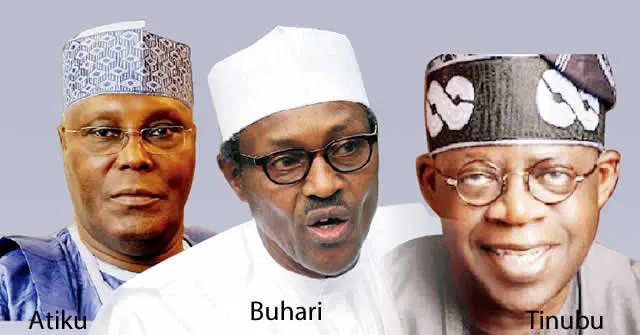
The most recent development is that, despite President Bola Tinubu‘s high-profile visit to Buhari’s family in Kaduna, supporters of the late former president Muhammadu Buhari have switched their allegiance to former Vice President Atiku Abubakar.
There is nothing more at risk. This is about who will actually inherit Buhari’s political group, not just about individuals.
State chairmen of Buhari’s original political platform, the now-defunct Congress for Progressive Change, or CPC, met privately at Atiku’s Abuja home a few days ago.
These individuals, who were once seen to be the core of Buhari’s northern power base, firmly backed Atiku’s alliance with the African Democratic Congress, or ADC.
Without a doubt, one CPC leader said, “Bring it out, make it visible.” Bring out your politics; politics does not operate in the corner. In essence, that is what we are here to highlight.
We are present today, sir, and we are Buhari’s loyal followers. There is still a CPC bloc. We shall not let the historic legacy that President Buhari has left on this nation’s history be erased.
It was not just a demonstration. It was a direct challenge that may have changed the political focus in northern states where Buhari’s name still has organisational and emotional clout.
Without holding back, Atiku greeted the group and framed the gathering as a fight to defend Buhari’s principles.
“I am especially happy to have you here today. This gathering is a continuation of your hardships and journey. I am confident that we can turn this trip into success with your help,” he stated.
He called on them to mobilise during voter registration, emphasising that endorsements must be converted into votes and that symbolism must become structure.
Buhari’s lasting influence is at the centre of this contest; in his farewell speech in 2023, he said, “I am confident that I am leaving office with Nigeria better in 2023 than in 2015.
” CPC loyalists contend that the APC has strayed from the ideals that once made it strong, and one former CPC state chairman cited well-known names like Malami and El-Rufai, stating that they still represent CPC loyalty in contrast to more recent leaders.
These are not only rhetorical parallels. They support a larger narrative that the APC has “derailed” from its core principles under Tinubu and that the fight for those principles will now determine the party’s and the political landscape’s destiny.
President Tinubu travelled to Kaduna over the weekend in the midst of this tense situation. He attended the wedding of Nasirudeen Yari, son of Senator Abdul’aziz Yari of Zamfara West, and paid a courtesy call to Aisha Buhari, the late president’s widow, at the family home. Although the trip was presented as a show of respect, it carried unavoidable symbolism.
Was it a calculated attempt to regain some of Buhari’s political base? The optics were potent: the sitting president was in Buhari’s home, speaking to his family, and reaffirming his presence in the northern networks where Buhari’s name is still known.
More than just a personality conflict, this is a battle over memory and who gets to define what Buhari stood for. Atiku, by joining the CPC bloc, positions himself as the guardian of Buhari’s emotional capital and grassroots networks, while Tinubu, by showing up in Kaduna, positions himself as Buhari’s legitimate political heir in the eyes of the public.
In Nigeria, symbols frequently open the door for substance, especially when a former leader’s memory still inspires devotion.
Voter registration is become a hot topic. Tinubu’s APC is trying to protect its stronghold in the north, while Atiku and the ADC are trying to increase their numbers.
The APC runs the risk of disintegrating in regions that were previously thought to be invincible if Buhari’s traditional base moves. For Tinubu, this entails strengthening allegiance with respectful actions, such as his trip to Kaduna.
For Atiku, it entails demonstrating that the CPC bloc’s backing is more than just rhetoric by converting it into voter turnout, grassroots allegiance, and registration drives.
Nigeria is undergoing one of its most conspicuous ‘legacy trials’ since the creation of the APC. Buhari’s political weight, formerly considered to be sealed within APC, is now challenged.
The APC runs the risk of being perceived as a party in decline if Tinubu is unable to maintain the course. Atiku and the ADC might be able to grab the narrative and the votes if they can transform symbolic gestures into concrete infrastructure.
One thing is certain: last weekend’s actions were not typical politics; they were the first steps in a struggle over legacy that could determine the fate of the APC, ADC, and the makeup of Nigeria’s leadership in 2027. Buhari’s loyalists have already decided on their course, and Atiku has seized the opportunity.
Tinubu’s visit to Kaduna stands as a dramatic countermove. The question now is not who will inherit Buhari’s legacy, but rather how profoundly loyalties will shift and whether they will be sufficient to redraw the electoral map.