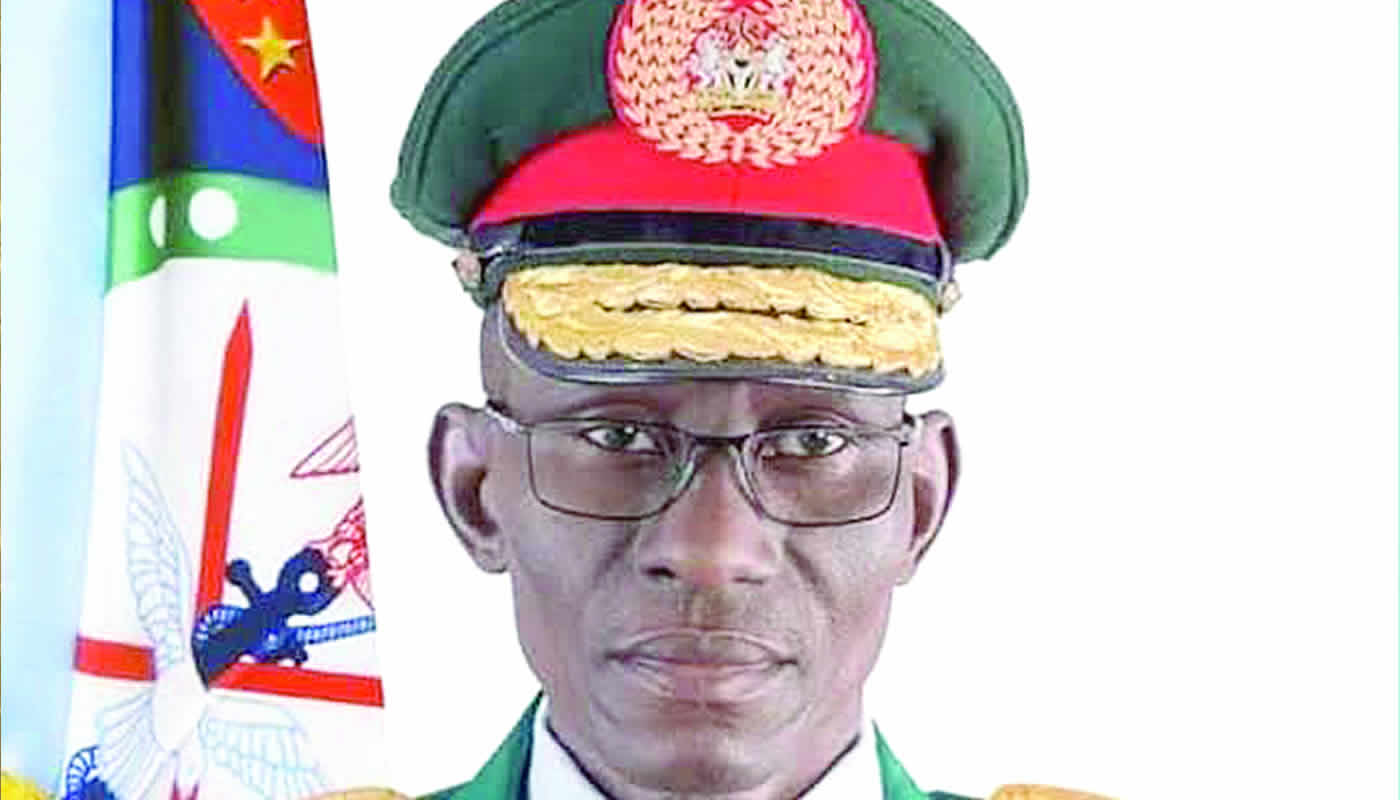
In his new book, ‘Scars: Nigeria’s Journey and the Boko Haram Conundrum,’ former Chief of Defence Staff General Lucky Irabor (retd) advocates for a state of emergency to address the Boko Haram insurgency. Irabor argues that the lack of political will has hindered Nigeria’s response to the insurgency and that an emergency proclamation backed by the National Assembly would be effective.
Irabor, who was the CDS under the Buhari administration, noted, “The government had not yet summoned the political will and instruments to declare war on Boko Haram. With an emergency proclamation supported by the National Assembly, the administration will pay more and more focused attention to galvanising all aspects of national strength for the fight.
“It should be highlighted that strategy addresses the sum of the elements of national strength. These are economic, political, social, diplomatic, informational, and military.
“The political authority is at the peak. Success at the tactical and operational levels will never result in triumph if the strategic level fails. In political contexts, tactical operations alone rarely provide the intended results.
Despite being weakened by the military after the execution of several of its senior commanders and the arrest of hundreds of its foot troops, Boko Haram’s attacks in the North have recently increased, resulting in significant destruction and displacement.
Last week, the group took over the border town of Kirawa in Borno State, prompting thousands to escape to neighbouring Cameroon.
The attack destroyed a military barracks, dozens of residences, and the district head’s palace. According to reports, around 5,000 individuals have fled to Cameroon as a result of recent violence.
Boko Haram gunmen also raided an army base in Borno State, killing four troops and burning military equipment. A concerted attack on security formations in Banki was thwarted by joint security forces, with one police constable receiving minor injuries.
Governor Babagana Zulum has advocated for increased military presence in border areas, emphasising the importance of appropriate security.
Nigeria continues to have more than 2.2 million internally displaced persons.
The group’s capacity to launch coordinated operations has overburdened security forces.
The humanitarian impact of the bombings has worsened, leaving many communities without access to basic essentials.
Brigadier General Peter Aro (retd.) described Irabor’s proposal as appropriate and based on extensive military and strategic experience.
He stated that a properly declared and legislatively supported state of emergency would provide unity and urgency to the struggle against insurgency.
Aro observed, “General Lucky Irabor’s opinion is both appropriate and well-informed by experience. With experience at the operational, strategic, and geostrategic levels, he speaks with the authority of someone who understands his surroundings.
“But it must be a genuine state of emergency—not one in which governors and local government chairmen continue to do business as usual. When politics is set aside and security takes full command, coordination improves, resources flow more quickly, and the chain of command becomes obvious. Such an approach, free of political interference, would allow the military and other agencies to operate with precision and integrity.
Retired Major General Dayo Olukoju agreed with Irabor, saying that while a state of emergency was required, it should be accompanied by a broader, multilateral approach that addresses the core causes of terrorism.
Olukoju responded, “I agree with him. However, as I have stated, a multilateral strategy should also be considered. I was in Maiduguri when we apprehended one of them, and the terrorist remained unrepentant. We have elite, traditional, spiritual, and military leaders; each has a job to play.
“The root causes exist; have we been able to investigate them?” These causes include questions of freedom and identity, among others. If these issues are not addressed, I hope we do not see a revival. I’m not saying the state of emergency can’t work; it’s ideal—but we can go further to accomplish what I previously stated.”
Col. Saka Folusho (retd.) added that declaring a state of emergency due to insecurity was not inappropriate.
He warned, however, that this would not solve Nigeria’s security challenges unless the authorities addressed the illicit trade in arms and ammunition that is fuelling the bloodshed.
“Yes, it’s appropriate to deal with the current situation, which is an emergency. There’s nothing wrong, but there are some issues we haven’t addressed. If you decide to sell ammunition, it signifies you are receiving a lot of attention from the other party you are selling to. Folusho added that if someone decides to sell something that is supposed to be used to defend oneself, it’s as if they wish to commit themselves.
He argued that commanders should be given clear responsibilities, and that soldiers be well equipped and not underpaid. “When you are paying somebody N50,000, you are not giving them all the equipment to operate.”
He also praised the Nigerian Army’s recent steps to improve indigenous manufacturing and skills, but urged for more consistent effort.
The Northern Elders Forum reaffirmed its call for a state of emergency to address instability in the country’s northern regions.
Prof. Abubakar Jiddere, the forum’s spokeswoman, stated in an interview with one of our journalists, “In one of our press releases, we called for this.” For the second time, we requested it twice. As a result, it is critical that the government declare a state of emergency in terms of security.
“That does not imply suspending the government or taking any other action. But rather by substantially deploying security forces. The police, the military, and all armed police officers will thereafter take extremely serious action.
“Areas prone to significant crises, including as Zamfara, Katsina, Niger, Kwara, Benue, and, of course, Borno, where Boko Haram operates.
“So, until the federal government takes decisive action and deploys enormous security troops, this issue will persist. It is a subject of national emergency. National emergency necessitates the proclamation of a state of emergency for insecurity in Nigeria, necessitating the deployment of large police forces.”
The federal government could not be reached for comment on Irabor’s plan. Mohammed Idris, the Minister of Information, pledged to answer, but he had yet to do so at the time of reporting this story.
Prof. Usman Tar, the Borno State Commissioner for Information and Internal Security, stated that Irabor is entitled to his opinion on the proclamation of a state of emergency due to insecurity.
‘He is entitled to his view; if you need any explanation, ask him. “We have nothing to say about that,” Tar replied.
Meanwhile, Kwamoti Laori, a member of the House of Representatives representing the Demsa, Numan, and Lamurde federal constituencies in Adamawa State, has stated that only state policing can address insecurity in Nigeria.
Speaking to a reporter in Yola, the Peoples Democratic Party federal senator stated that state police are the best solution to the country’s insecurity, citing experiments in the 1960s that proved effective.
“In the 1960s, we had state police in my district, Numan, who were known as Friday police since they only worked on market days to aid federal police in controlling crime on those days.
“When people with criminal intentions see the Friday police, they are terrified because the Friday police know their names and addresses, and if they do anything, they may be tracked down and arrested. So there was fear of committing a criminal,” he explained.
On how to govern the state police without politicians exploiting the initiative, he stated that the law establishing the state police should allow communities to propose recruits.
“The reason is that they know the criminals in their communities, so they will not nominate such youth; everyone recruited will not be posted to another community, it will be his area where he knows everyone.”
In a similar event, the African Democratic Congress (ADC) has chastised President Bola Tinubu for what it calls his administration’s insensitivity to the country’s deteriorating security situation.
In a statement made on Sunday via X by the party’s National Publicity Secretary, Bolaji Abdullahi, the ADC accused the President of failing to fulfil his constitutional duties as Commander-in-Chief of the Armed Forces while nationwide insecurity escalated.
The party slammed Tinubu’s regular attendance at social and political events amidst growing attacks and killings, calling it “unacceptable and irresponsible.”
According to Abdullahi, nine local government districts in Kwara State, which were previously famed for their tranquilly, were recently assaulted by armed bandits, who allegedly compelled inhabitants to deliver food, drinks, money, and other stuff as ransom.
He stated that a similar attack took place in Kogi State, where passengers were slain and several others, including women and children, were kidnapped.
“The President’s claim of progress in the fight against insecurity is a tragic denial of reality,” Abdullahi stated, claiming that Tinubu’s actions had further split the country.
” The ADC recommended the federal government to recognise the severity of the security situation, interact directly with affected communities, improve military and police deployment coordination, and offer comprehensive public reporting on security operations and spending.
“Nigeria is being attacked. This administration needs to quit pretending differently. “The time for symbolic gestures is over; the country now requires responsible leadership, operational urgency, and measurable results,” the statement said.
The All Progressives Congress (APC) argues that Nigeria is moving from a period of insecurity to greater national security, citing recent arrests of high-profile kidnappers and gang leaders as evidence of the government’s commitment to protecting citizens and stabilising the country. Bala Ibrahim, APC Director of Publicity, believes the ADC is confused and has failed to gain acceptance among the populace.
“Yes, there are difficulties here and there, but the pace with which they are being addressed demonstrates that the APC takes security seriously. Don’t forget that the APC government recently announced the arrest of the most prominent kidnappers and thugs terrorising the entire West African region.
“These people have been apprehended and detained, and their admissions are assisting security personnel in putting a stop to these activities. So, whatever the ADC says is motivated by desperation because they have failed to acquire the acceptance of Nigerians.”